
September 15, 2023 by Adam and Dianne Riveiro
“Is your child high functioning or low functioning?”
“My nephew has a touch of autism too.”
“What’s your child’s special gift?”
“I have special needs too!”
“I’d never know, she seems so normal.”
“Does he need medication?”
Heard any of these before? If you’re a special needs family (and particularly an autism family), you’ve heard them all…and more. Each of the quotes above has been said to Dianne and I over the years. Can you relate?
However, this post isn’t about building awareness so that people stop saying things that are incorrect, insensitive, or intrusive. Instead of focusing on THEM, I want to speak to YOU for a few moments.
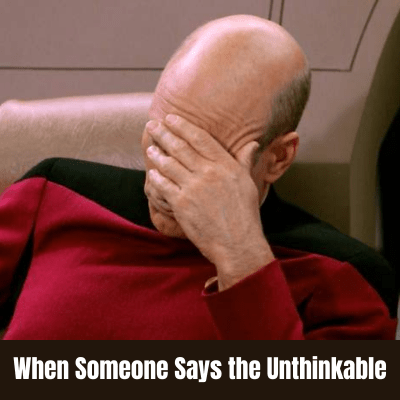
Why? Because every once and a while people are going to say things about your family’s special needs diagnosis that’ll set you on edge. You’re not going to be able to stop people from making these types of comments, but you CAN keep a proper perspective when it happens. Here’s some thoughts to help when someone says the unthinkable:
1) Remember that most people aren’t aware of the correct terminology relating to the special needs community.
Look, people in the special needs community don’t even agree with each other on what terms are correct! Is the correct term a “child with autism” or an “autistic child?” Should we say “handicapped,” “handi-capable,” “differently abled,” “disabled,” or something else entirely? People outside of the special needs community are simply not going to stay on the cutting edge of this merry-go-round of terms and phrases that are acceptable (and let’s be honest, who actually decides what’s acceptable anyway?). Just by the very nature of how confusing this issue is, you should always be ready to extend grace to those who want to talk to you about your family’s special needs diagnosis. Two characteristics of the fruit of the Spirit come to mind: longsuffering and gentleness (Galatians 5:22).
2) By getting offended at everyone who says something “wrong,” you’re doing more harm than good.
Our culture has become so hypersensitive that saying almost ANYTHING can be offensive! This is true of the special needs community as well (see #1 for reference). If you are constantly correcting people on how they speak about your child, people will stop saying things that hurt your feelings…because people will just stop talking to you! If you want to foster conversation and advocacy for special needs children, be willing to converse with people who don’t understand where your family is coming from—and do it without being easily offended. Psalm 119:165 says, “Great peace have they which love thy law: and nothing shall offend them.” You can’t get offended every time someone says something that’s “off.” Period.
3) Realize that the vast majority of people who use outdated terminology in relation to special needs children aren’t coming from a bad place.
When someone says something that raises your hackles, immediately take stock of the situation. Did the person use a word or a term as a slur to mock a special needs child? If they did, this is unacceptable. In these cases, it would seem that “out of the abundance of the heart the mouth speaketh.” (Matthew 12:34). However, almost every person I’ve come across over the years who said the unthinkable was speaking out of a heart of concern and love for our family. Might they be ignorant about special needs? Most definitely. But you can help them work through that ignorance if you’re swift to hear, slow to speak, and slow to wrath (James 1:19).
4) Sometimes people say awkward things when they don’t know what to say.
We all do this at some point or another, don’t we? What do you say to the friend you bumped into at the store after their recent divorce? What about the coworker who just came back to the office after their mom died? How do you approach the neighbor who was recently diagnosed with cancer? Let’s be honest, sometimes we fumble the ball because, in the effort to connect with the person we’re talking to, we end up saying something excruciatingly awkward. Don’t mistake someone’s awkwardness for callousness. They’re two entirely different issues.
5) When people are rude, ask God at the very moment for grace to respond in a Christ-like manner.
I have to admit that some people are just plain old rude. Some are busybodies who want to know the intimate details of your life for some unknown reason. Others are asking about your difficulties as an avenue to launch into a tirade about their own problems. When you meet one of these folks, don’t respond in kind. When Stephen was about to become the first martyr in Acts 6, the Bible says that his countenance was like an angel. Yes, while false witnesses accused him, he maintained his integrity and spirit. I truly believe the image of Stephen’s angelic face haunted Saul of Tarsus when he went to sleep each night. It likely played a part in the softening of his heart before he met Christ on the Damascus Road..
If someone says something to you that sets your teeth on edge, mentally train yourself to ask the Lord AT THE VERY MOMENT for Holy Spirit leadership over your mouth and your facial expressions. If you want to have an impact on those around you for Christ, like Stephen did, you must learn to control these impulses with the Spirit’s help.
In the end, I’m always glad to engage with folks who don’t know much about special needs and try to help them understand what children like AJ deal with on a regular basis. But to do that, you’ll need to put yourself out there a bit. And by putting yourself out there, people will say some very (very!) strange things. When those times come, remind yourself of the inspired wisdom of Solomon when he said in Proverbs 16:32, “He that is slow to anger is better than the mighty; and he that ruleth his spirit than he that taketh a city.”
To receive articles and blog posts on a regular basis directly to your inbox, sign up for “The Writer’s Block” by clicking here.
 Ready Scribe Publications